Heya. Welcome to the site of Darren Krape, a web designer and developer. When not building sites, I am hopefully travelling the world! More about me

Archive

You are currently browsing entries tagged to 'Portugal'.

Portugal Travel-Log: Part 2, Porto and the Return to Lisbon

Posted 22 July 2007 Tagged to ,

Read Portugal Travel-Log: Part 1, Lisbon and CoimbraModern Lisbon and classic Coimbra, home to one of the world’s oldest universities

Porto

The next morning brought cold rain and an early departure for Porto, further to the north. Portugal’s second largest city and famed for its sweet Port wine, Porto stands gracefully above the northern banks of the Douro River. Arriving on the train, the first thing a visitor will notice are the towering bridges that connect Porto and its more modern neighbour Vila Nova de Gaia. One such span, the Dom Luís I Bridge, arches majestically over the river and brings to mind images of Paris’ Eiffel Tower. This is no accident; the bridge’s designer, Léopold Valentin, was one of Gustav Eiffel’s young protégés.
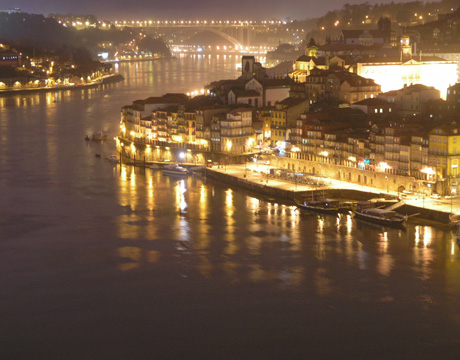
The lights of Ribeira glisten in the cool night air, the historic center of Porto, declared a UNESCO World Heritage Site in 1996 (Portugal's 8th)The lights of Ribeira glisten in the cool night air, the historic center of Porto, declared a UNESCO World Heritage Site in 1996 (Portugal’s 8th)Parts of Porto, with boarded up buildings and scrawled graffiti, hint at the city’s hard-scrabble past as a shipping port and decades of economic despondency. Closer to the Douro River, the buildings are older and the area more well-preserved. Riberia, belying Porto’s more recent economic struggles, is an exquisite gem of august architecture, fine restaurants and majestic bridges. UNESCO certainly thought so, naming Riberia a World Heritage Site in 1996. Dining on Portugal’s superb cuisine and sweet Port wine with the Don Luis I alight in the darkness as a backdrop is truly a singular pleasure.
Lisbon, Once Again

After a short train ride from Porto, I was once again in Lisbon for the final days of my journey. Arriving into Lisbon via train is an aesthetic pleasure. Gradually you close in to the city, with its stately hills falling into the broad Tagus river-side. The train then pulls into Oriente Station, its radiant lattice-work canopy towering high above the station platform. Designed by Spanish master Santiago Calatrava, the station is further part of the 1998 World Expo complex. After a quick check-in at the hotel, I again set out onto the streets of Lisbon ready for my next discovery.

Museu Nacional de Arte Antiga

While exploring Barrio Alto, I stumbled upon one of Lisbon’s great museums, the Museu Nacional de Arte Antiga. Given the nation’s religious tradition, the crucifixion of Christ is a reoccurring theme in this museum’s bountiful collection. Through a wide variety of media, Christ is depicted in graphic detail dragging his cross, being nailed to it, suffering almightily for our sins, dying and, finally, blessedly, being removed from said cross and laid to rest in a cave, ready for his imminent resurrection. The excruciating exactitude of many of the works border on the macabre. Alas, much of the rest of the museum was closed for renovation, so Christ’s allegorical agony will be my most vivid memory of the Museu Nacional de Arte Antiga.

Belém Tower and the Mosteiro dos Jerónimos

 With the nearby Mosteiro dos Jeronimos, Belem Tower tower was classified a National Monument in 1910 and a UNESCO World Heritage Site in 1983With the nearby Mosteiro dos Jeronimos, Belem Tower tower was classified a National Monument in 1910 and a World Heritage Site in 1983Not wanting to waste time, I caught an aging Mercedes taxi that bounced along cobble-stone streets to Belém Tower. Standing guard at the mouth of the Tagus River, the alabaster tower is a sight to behold. Built in the to commemorate the expedition of Vasco de Gama and as part of the city’s defensive system, Belém Tower has since become a widely-recognized symbol of Lisbon. And rightly so, the tower’s elegant stone-work and refined form make for a striking gateway into the city while handsomely disavowing the Tower’s original militaristic intention.

A short walk from Belém Tower is Mosteiro dos Jerónimos (Jerónimos Monastery) and the Church of Santa Maria, the three together composing UNESCO’s 263rd World Heritage Site. Built by Manuel I to commemorate Vasco da Gama’s return from India, the church and monastery are true products of Portugal’s “Age of Discovery”. Replete with intricate nautical motifs and design influences from around the known world, the complex is a sight to behold.

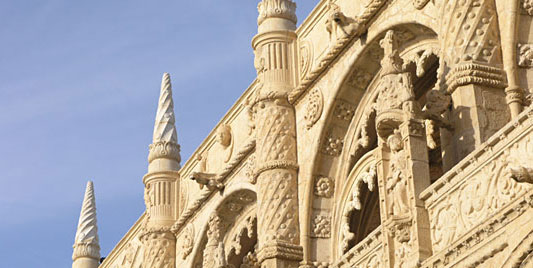
Originally intended for the burial of the House of Aviz, the Church of Santa Maria instead became a house of prayer for departing Portuguese marinersIntended for the burial of the House of Aviz, the Church of Santa Maria instead became a house of prayer for departing Portuguese marinersMost immediate is the church, an opulent mix of Gothic and Renaissance styles and considered one of the most magnificent works of its time. Inside, cascades of light from the setting sun flood the vaulted interior, the raised crucifix casting a deep shadow across worshipers below. The warm illumination fills the nave with an unearthly radiance. It is easy to imagine adventuresome explorers receiving divine inspiration while praying before their next voyage into the unknown.

Just beyond the church is the Jerónimos Monastery, a sumptuous late-Gothic cloister built using pedra lioz, a local gold-colored limestone. Fittingly, the construction was funded with a 5% tax on the spice trade. The riches of the spice trade allowed the designers wide latitude, resulting in resplendent ornamentation throughout the majestic passageways and cloister. A recent renovation has restored the gold limestone to its original glory.

Castle of São Jorge

While darkness descends on Lisbon, as viewed from Castle Sao Jorge, the city begins to awake with the sights and sounds of celebrationsWhile darkness descends on Lisbon, as viewed from Castle Sao Jorge, the city begins to awake with the sights and sounds of celebrationsWith the daylight quickly receding, I hailed an ancient Mercedes taxi and sped across Lisbon’s narrow and jarring cobblestone streets to the Castle of São Jorge. Situated on the highest hill in the city and at the heart of historic Lisbon, the Castle of São Jorge occupies a commanding point above the capital. The castle’s towering citadel, with its narrow passages and precipitous heights, make for adventurous exploration. It is also an ideal vantage point to enjoy the shimmering threads of light that twist through the Lisbon metropolis.

With the day put to rest and another lively Lisbon night awaking, the view was a perfect coda to another fantastic journey. The following day would bring a day of lengthy flights, customs queues and the myriad of travels facing the modern traveler. Through it all, it was poetic to be returning to the new world on trails blazed by Portuguese explorers so many years before.

View Portraits of Portugal: Journeys through Lisbon, Coimbra and PortoMysterious gardens and historic monasteries, modern aquariums and majestic skylines

Read Comments

Portraits of Portugal: Journeys through Lisbon, Coimbra and Porto

Posted 8 May 2007 Tagged to , ,

Portraits of Portugal: Journeys through Lisbon, Coimbra and Porto

Perhaps it was the promise of old-world European elegance, with mysteriously hidden side-streets and quaint restaurants, or the chance to utilize my meager Brazilian Portuguese. Whatever the reason, Portugal became my second foray into Europe thus far. Between its great food, wonderfully unique scenery, storied history and quick public transport network, this gem on the Iberian peninsula did not disappoint.

Read full entry...

Portugal Travel Log: Part 1, Lisbon and Coimbra

Posted 22 April 2007 Tagged to ,

Generally I travel on short notice and with little planning. For me, aimlessly wandering secreted urban streets and directionless forest paths is the true appeal of travel. Metered hours in an unknown landscape leaves little time for the majesty of the unexpected. It was in this spirit that I set out for Portugal, with dreams of old-world charms ripe for exploration. Visiting the hub of new world discovery as one of my first European forays added to the appeal.

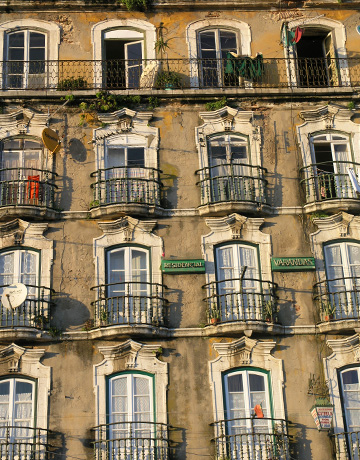
Elegant residences line the streets around the Baixa Pombalina (or Pombaline Lower Town), rebuilt following the devastating 1755 earthquakeElegant residences line the streets around the Baixa Pombalina (or Pombaline Lower Town), rebuilt following the devastating 1755 earthquake

My itinerary was, perhaps, rather ambitious: three cities, one of them the metropolis of Lisbon, in a scant five days. Alas, the timing was beyond my control, so smooth traveling was subject to capricious winds of fate. Fortunately, Portugal boasts something all too lacking from my past travels: a first-world transportation system. While not France’s TGV or Japan’s Shinkansen lines, Portugal’s aptly named Comboios de Portugal (Portuguese Trains) is an easy, if leisurely, way to traverse the country without risking life and limb on the nation’s precarious roadways.

Lisbon

My first introduction to Lisbon, and indeed Portugal, came from the view from my hotel near the Parque Eduardo VII and just off the city’s main thoroughfare, Avenida da Liberdade. Stretched out before me was Lisbon’s old-city, with the Castle of São Jorge standing proudly on a crest to the right and the Tagus river arching out toward the Atlantic to the left.

Not wanting to linger in my room, I set out to Parque das Nações (Park of the Nations), a collection of museums, cultural monuments and shopping malls built for the 1998 World Expo. My ultimate destination was the Oceanário de Lisboa (Lisbon Aquarium). The center-piece of the 98 Expo, the aquarium is beautifully designed, engaging and not to be missed. A vast central tank houses a grand diversity of sea life while each corner of the building features a different aquatic habitat: from entertaining penguins to charming North American otters to striking tropical fish.

Lisbon's redeveloped and elegant Pombaline BaixaThe red-hued moon ascends above Lisbon’s lower town, Pombalina

The next day was spent in blissful aimlessness as I wandered the streets of the city. Although parts Lisbon were rebuilt on a strict grid after the devastating 1755 earthquake, most of the lower town’s old streets and alleys still meander their way to the river. It is easy to get lost here. It is a pleasure to get lost here, amid the fluttering laundry and small cafés tucked into each corner. Despite the electric lights and occasional café television (always tuned to Portuguese football), little imagination is needed to feel the pulse of centuries old Lisbon. Majestic cathedrals and cloistered monasteries were among the many sights. As night descended and a full moon rose above the city, I sat above Alfama and the Tagus River and enjoyed the cool evening air.

Coimbra

The 16th century Sao Sebastiao (Saint Sebastian) aqueductThe 16th century Sao Sebastiao (Saint Sebastian) aqueduct

As the cool morning dawned, I set off for Coimbra, home to the oldest university in Portugal and one of the oldest in the world. Departing from Lisbon’s striking Gare do Oriente station, I settled in for the quick ride north. Situated upon a hill, overlooking the Mondego river, old Coimbra is a warren of small steep side streets punctuated by renaissance-style cathedrals and ornate university buildings. A Romanesque aqueduct bisects the old-town. Quixotically, many of the university’s central buildings were built in the 1960’s, in an unadorned brutalist style. It is easy to see why Coimbra is called the “cidade dos estudantes” (city of the students). One can see the university’s students, in their unique dark uniforms, throughout the city. Their colourful multi-lingual graffiti scrawled on ancient walls is similarly omnipresent.

The Botanical Garden of the University of Coimbra (or simply Jardim Botanico) which was founded by the Marquis of Pombal in the 1770sThe Botanical Garden of the University of Coimbra (or simply Jardim Botanico) which was founded by the Marquis of Pombal in the 1770s

The highlight of Coimbra for me is the Jardim Botânico da Universidade de Coimbra, which date from the 18th century. Sprawling 13 hectares, the gardens are a mystical collection of wide stone-hewn paths, graceful iron gates and moss-covered fountains. This is the garden of fairy tales and children’s story books, where monsters creep and faun’s hide in the shadows.

My only night in Coimbra was spent at the Astória, a turn of the century hotel on the banks of the Mondego River. Its well-worn iron and glass-lined elevator and luxuriant smoking lounge harkened back to a long passed era. The tired décor, antique electronics and ubiquitous exposed compact fluorescents bulbs were reminders of a more modern era. While charming and worth a night for the sheer novelty, the Astória was long-past its prime. The restaurant’s food, in contrast, is not to be faulted and ranks as one of the most satisfying meals from my time in Portugal.

Read the Portugal Travel Log: Part 2, Porto and the return to Lisbon The majestic Douro river, sweet Port wine and the historic sights of Lisbon

Comment on this entry...